
Reseller guides
How to Price Items to Sell on eBay: Thrift Finds, Sold Comps and Shipping

You found something good at the thrift store. Now the hard part: what do you ask for it? Price too high and it sits for months. Price too low and you find out later it sold for double somewhere else. Here’s how to price items to sell on eBay the way experienced resellers do, using what things actually sold for, with condition, shipping and fees built in.
The short version
- Search eBay for the item and turn on the Sold items filter.
- Keep only the sales that match yours: same item, same size or version, similar condition.
- Note the middle of that range, not the single highest sale.
- Look at how many are listed right now compared with how many sold.
- Adjust for your item’s condition and decide whether shipping is free or buyer-paid.
- Check that the price still leaves you a profit after fees, shipping and what you paid.
Step 1: Find real sold comps
“Comps” (short for comparables) are recent sales of the same item. They’re the single most useful number in reselling, because they show what buyers really paid, not what sellers hope to get.
- In the eBay app: search for the item, tap Filter, turn on Sold items, and apply.
- On a computer: search, then tick Sold items under “Show only” in the left column.
Sold prices show in green. The regular sold search covers roughly the last 90 days. For older or slower items, eBay’s Product Research tool (formerly Terapeak) in Seller Hub goes back much further; eBay’s Product Research help page explains how it works.
How to read the results honestly:
- Match exactly. Same brand, model, size, color and edition. A first edition and a book club edition are different items.
- Ignore the outliers. One sale at three times everyone else is luck (or a bundle). One at half price may have been broken. Look for where most sales cluster.
- Watch for crossed-out prices. A crossed-out price usually means the item sold through Best Offer for less, and the regular search doesn’t show how much less. Product Research can show more.
- Add shipping in your head. A $25 sale with $9 shipping and a $34 sale with free shipping are about the same price to the buyer.
- Count the sales. Ten sales in 90 days is a reliable picture. One sale is a hint, not a price.
Tip: check comps before you buy, standing in the aisle. Our thrift store buying guide covers what tends to sell and what just sits.
Step 2: Check the competition
Now turn the Sold filter off and look at what’s listed right now. Two numbers tell you a lot: how many sold in the last 90 days, and how many are for sale today.
- More sold than listed: buyers are snapping these up. You can price toward the top of the sold range.
- About even: price in the middle of the sold range and expect a normal wait.
- Many more listed than sold: the market is crowded. Price toward the low end, or be ready to wait a while.
Ignore active listings priced far above the sold range. They’re not your competition; they’re the ones that aren’t selling.

Step 3: Adjust for condition
Comps only help if they’re in the same shape as yours. Go over your item in good light before you set a price: stains, holes, chips, cracks, missing pieces, odors, wear on corners and edges.
- New with tags or sealed: compare only with new-with-tags or sealed sales. They often sell well above used.
- Excellent used: the middle of the used comps.
- Visible wear or a small flaw: the low end of used comps, with the flaw named in the title or description and shown in a photo.
- Missing parts or for repair: compare with “for parts or not working” sales only.
Disclosing a flaw costs you a few dollars on the price. Hiding it can cost you the whole sale in a return, plus shipping both ways.
Step 4: Decide who pays shipping
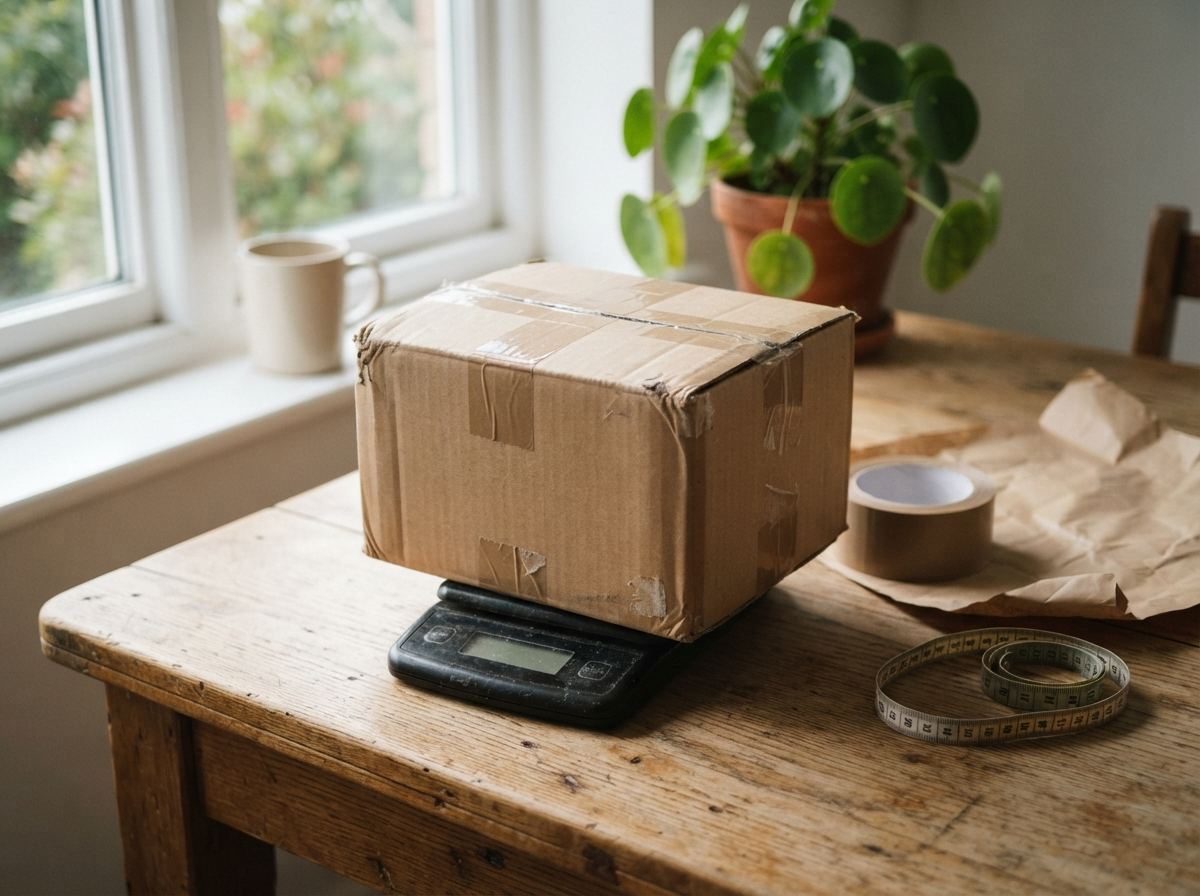
Shipping is where many reseller profits quietly disappear. Before you set a price, weigh the item packed (box and padding included) and measure the box. Then choose:
- Free shipping: build the label cost into your price. Buyers like it, and it works well for light items with predictable postage, like clothing and small goods.
- Calculated shipping: eBay charges each buyer the real postage to their address. Safer for heavy or bulky items, where postage across the country can be much more than across town.
- Flat rate you set: one shipping price for everyone. Simple, but set it from a far-away zip code, not your own.
USPS Ground Advantage is the usual choice for small packages; see the USPS Ground Advantage page for size and weight limits. And keep packaging cheap: our shipping supplies guide shows where to save.
Step 5: Do the profit math
For most categories, eBay’s final value fee is 13.6% of the total the buyer pays (item, shipping and sales tax), plus a small per-order fee ($0.40 on orders over $10, $0.30 on $10 or less). Some categories, like books and movies, cost more. Rates change, so check eBay’s selling fees page for your category.
Example: a wool sweater you bought for $6. Sold comps cluster around $30–$36 with free shipping.
Your price, free shipping: $34.00
− eBay fees (13.6% of about $36.40 with a typical sales tax, plus $0.40): about $5.35
− Shipping label (about 1 lb, Ground Advantage): about $6.00
− Mailer: about $0.50
− What you paid: $6.00
= Profit: about $16.15
Many resellers set a minimum profit they’ll accept per item (say $10 or $15) and skip anything that can’t clear it. If an item only makes $3 after everything, it’s probably not worth the time to photograph, list, store and ship. That cost you paid at the store is also what matters at tax time; see our cost of goods sold guide.
Step 6: Pick the format and the price
- Buy It Now with Best Offer is the everyday choice for thrift finds. Price a little above where you’d be happy (for example, 10–15% above your target) to leave room for offers.
- Set an auto-decline. eBay lets you automatically decline offers below an amount you choose, so lowball offers never reach you. Set it at your floor.
- Auctions make sense for items with lots of eager buyers or when you truly don’t know the value. For most everyday finds, Buy It Now earns more.
- Price endings: $34.99 or $34 both work. What matters far more is being inside the sold range.
Once it’s listed, give it time before you cut the price. Our guide on when to lower your price on eBay covers how long to wait and how much to drop.
When there are no comps
Rare, handmade or unbranded items sometimes have no exact sales. Work outward:
- Search wider. Drop the size or color, try the maker’s name alone, or search by material and era (“mid-century stoneware vase”).
- Search the older data. Product Research covers far more than 90 days.
- Look at similar items. The same type from a comparable maker gives you a range.
- Start high with Best Offer. Offers (and watchers) tell you what buyers think it’s worth. Lower gradually if nothing happens.
Common pricing mistakes
- Pricing from active listings. Asking prices tell you what sellers want, not what buyers pay.
- Copying the single highest sale. Price to the middle of the cluster.
- Forgetting shipping. Free shipping on a 6 lb item can wipe out the profit.
- Forgetting fees. Roughly 14% comes off the top, shipping and tax included.
- Ignoring condition. Your stained shirt isn’t the same item as a new-with-tags one.
- Losing track of what you paid. Without your cost, you can’t tell whether a price or an offer is a good one.
Quick answers
How do I see sold prices on eBay?
Search for the item, then turn on the Sold items filter (Filter › Sold items in the app, or “Show only › Sold items” on a computer). Sold prices show in green and cover roughly the last 90 days.
What’s a good markup for thrift store items?
There’s no single rule. Many resellers look for items that sell for at least three to five times what they paid, but a fixed minimum profit in dollars is often more useful: a $2 item that sells for $8 is a 4x markup and still barely worth listing.
Should I offer free shipping on eBay?
For light items with predictable postage, free shipping with the cost built into the price works well. For heavy or bulky items, calculated shipping protects you from expensive cross-country labels.
Does eBay charge fees on shipping?
Yes. The final value fee is charged on the total amount of the sale, which includes what the buyer pays for shipping and sales tax.
How ReNventory helps
- Your cost, captured in the aisle. Log a find with a photo or barcode and snap the price tag; ReNventory reads what you paid and saves it with the date and store, even with no signal.
- A searchable title from the photo. Tap Renny, what is this? and Renny suggests an eBay-style title, a handy starting point for your sold-comps search.
- Cost and asking price side by side. For listings linked to eBay, the Inventory cards show what you paid and what it’s listed at, so you can judge an offer at a glance.
- Lots split for you. Paid one price for a box? ReNventory spreads the total across the items, so every find has a cost to price against.
- Your real profit. Reports show sales, cost of goods sold, profit and the average days from buying to selling. Need a SKU format for your listings? Try the free eBay SKU generator.