
Reseller guides
The Real Death Pile: How to Write Off Damaged and Dead Inventory

Every reseller jokes about the death pile: the stuff you haven’t listed yet. But there’s a second pile nobody likes to talk about, where items really are dead. Stained, torn, cracked, missing pieces, not worth the shipping. That pile costs real money, and most of us never count it. Here’s what’s in it, what to do with it, and how to make sure the loss at least counts at tax time.
There are two death piles
The one we all know is the waiting-to-list pile: good stock that just hasn’t been photographed and listed yet. It ties up money, but the money is still there. List it and it comes back. (We wrote a whole guide on shrinking that one.)
The real death pile is different. These are the items that will never sell for what you paid, or at all. The sweater with a moth hole you spotted when you steamed it. The jeans with a stain that won’t come out. The vase with a hairline crack you found when you washed it. The game with half the pieces missing. The money in this pile is already gone. The only question is whether you count it.
How an item ends up dead
Hardly anything is dead when you buy it. It dies on the way to being listed, usually in one of these steps:
- Waiting to list. It comes home with everything else and goes into a bin.
- Cleaning and prep. You wash and steam it, test it, count the pieces. This is where most problems show up.
- Problem found. A stain, a hole, pilling, a broken zipper, a smell that won’t wash out. A crack, a part that doesn’t work, a missing piece. Or it was fine, but it sat so long it’s out of season or out of style.
- Decision. Fix it, sell it as-is for less, or let it go.
- Gone. Donated, thrown away, or sold somewhere cheap.
The trap is step 3. Items with a problem get set aside “to deal with later” and land in a box by the door. That box quietly becomes the real death pile, with no number on it.

Donate, trash or sell it cheap?
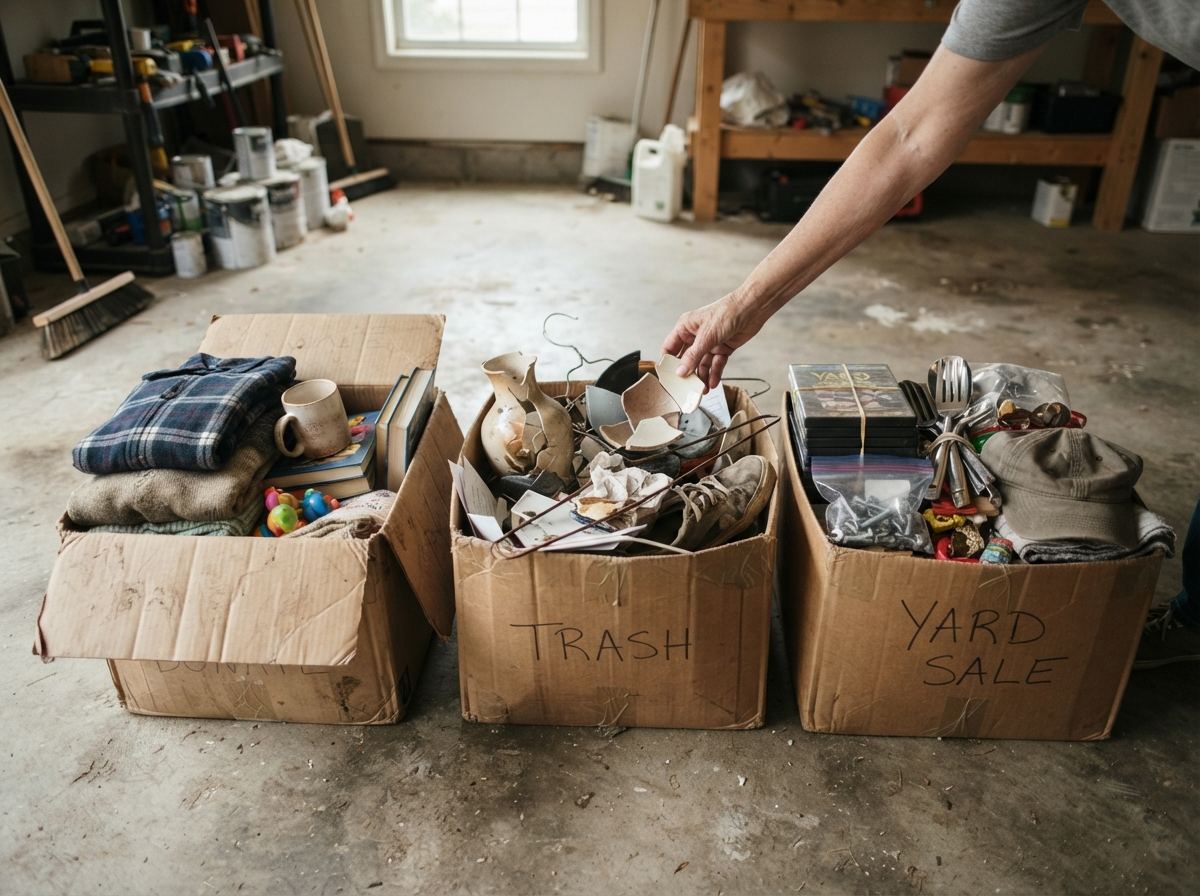
Once an item is dead, you have three ways out. Each one ends the same way for the item but differently for your money:
- Donate it. Quick, clears the space, and someone gets use of it. You get nothing back for it, so the whole cost is a loss. Get a receipt if the store gives one, and note what was in the bag.
- Throw it away or recycle it. For broken, unsafe or truly worn-out items. Clothing too stained or torn to wear can often go to a textile recycling bin instead of the trash. Either way it’s a full loss of what you paid. Snap a photo of the damage first: it’s your proof the item existed and why it went.
- Sell it for less. A bundle of flawed tops listed as a lot, a “for crafts or repair” listing, a bag sale at a yard sale, or a local group. If you paid $8 for a jacket with a stain and sell it for $3, you lost $5 instead of $8. Worth it when it’s quick; not worth hours of your time.
Rule of thumb: if selling it cheap takes more than a few minutes, or the item would sell for less than a couple of dollars, donate it and move on. Your time is worth more than the difference.
The real numbers
Dead stock adds up faster than you think. A few quiet examples:
- Small losses, all year. Five dead items a month at about $3 each is $180 a year you paid for and never got back.
- One bad lot. A $60 bag of estate sale clothes where a third have stains or holes: $20 of dead stock in one afternoon.
- One damp bin. Fifty pieces of clothing at $3 each, stored in a garage through a humid summer, come out smelling of mildew. $150 gone.
You can’t get that money back by selling the items. But you can make sure it counts as the business cost it really is, and that only works if you know what each item cost you.
How to write off damaged inventory at tax time
This is the part most resellers get wrong, in both directions. The short version: a dead item’s cost is written off once, through your cost of goods sold.
Inventory isn’t an expense on the day you buy it. It’s money parked in stock. It becomes an expense when the stock leaves your hands: sold, donated, thrown away, or ruined. At the end of the year, the math looks like this (our cost of goods sold guide walks through it):
Inventory at the start of the year + what you bought − sellable inventory at the end of the year = cost of goods sold
Say this was your year, including that mildewed bin of clothes that cost you $150:
- Inventory at the start of the year: $1,000
- Bought during the year: $5,000
- Sellable inventory at the end of the year: $1,850 (the mildewed bin isn’t sellable, so it isn’t counted)
- Cost of goods sold: $1,000 + $5,000 − $1,850 = $4,150
The $150 bin is already inside that $4,150: that’s the write-off. What you can’t do is also list a separate $150 “damage loss” on top, which would count the same $150 twice. There is a separate route for sudden losses like fire, storms or theft (IRS Form 4684), but items claimed that way have to come out of cost of goods sold. One or the other, never both.
Donated inventory works the same way. Its cost is already in your cost of goods sold, so a business generally can’t take a second, separate charity deduction for the same items. And an item sold below cost needs nothing special: it just makes a smaller profit, or a loss, on that sale.
Here’s why counting it matters. If dead items never get written down, they quietly stay in your year-end inventory as if you could still sell them. Count the mildewed bin as stock and your ending inventory becomes $2,000, your cost of goods sold drops to $4,000, and you pay tax on $150 of profit you never made. The dead pile you don’t count costs you twice: once when you bought it, and again in April.
This is general information, not tax advice. The IRS covers inventory in Publication 334 (Tax Guide for Small Business), donations in Publication 526 and sudden losses on Form 4684. For your own return, ask a tax preparer.

What to write down
For every item that goes to the real death pile, keep a short record. It takes seconds if you already logged the item when you bought it:
- What it was and what you paid for it (the cost you logged when you bought it).
- Why it died: damaged, missing pieces, dirty, or just not selling.
- What happened to it and when: donated, thrown away, or sold for how much.
- Proof, if you have it: a photo of the damage, a donation receipt.
The cost is the part you can’t fill in later. If you didn’t write it down when you bought the item, you’re guessing, and a pile of guesses is hard to stand behind. That’s the real reason to log every find at intake, before anything can go wrong with it.
Keeping the real pile small
- Inspect in the store. Check armpits, cuffs and collars for stains, hold knits up to the light, try zippers, smell fabric. Check for chips and cracks, count the pieces, test what you can. Thirty seconds in the aisle saves the whole cost.
- Clean and check soon after you buy. Problems found in the first week are easier to return, fix or resell.
- Give problem items one place. A “needs work” bin, not a heap by the door, so you can see how big it is.
- Have a decision day. Once a month, go through that bin: fix, sell cheap, donate or trash. Write each one down.
- Store it dry. Clothing and paper go in sealed bins off the floor, not open bags in a damp garage.
- Learn from it. If the same kind of item keeps dying (white tops that stain, cracked glass, incomplete games), buy less of it.
Quick answers
Can you write off damaged inventory?
Yes, as long as you know what it cost you. Damaged or worthless stock isn’t counted in your year-end inventory, so its cost flows into cost of goods sold; that’s the write-off. Keep a note (and a photo) of what was damaged and when.
Is there a tax deduction for donated inventory?
Their cost counts, through your cost of goods sold, as long as you recorded what you paid. For business inventory that’s generally the whole write-off; there isn’t a second charity deduction on top. Ask your preparer if you’re not sure.
What if I never wrote down what I paid?
Make your best honest estimate now and note how you got it, then log costs as you buy from here on. Estimates are weaker than records, so the sooner you start, the better.
Is it worth selling something for less than I paid?
Often, yes. Getting $3 back on an $8 jacket beats getting nothing, if it doesn’t eat your time. The $5 shortfall shows up on its own as a smaller profit or a loss on that sale.
Is this the same as the death pile I already have?
No. The waiting-to-list pile is good stock you haven’t listed; its money comes back when you list it. The real death pile is stock that will never sell for what you paid. Both need a number, but only one needs a write-off.
How ReNventory helps
- Every cost logged at intake. Snap the item (and its price tag) in the store and what you paid is saved with today’s date, even with no signal. Nothing reaches the death pile without a cost.
- A Death Pile stage with the story. Move an item there with a reason (damaged, missing pieces, dirty, not selling) and what happened (donated, written off, or sold elsewhere for how much). Its cost is kept for your records.
- Your losses, counted. The Dashboard shows death pile losses this month, this year and all time, including the shortfall on items sold for less than they cost.
- Ready for tax time. The Reports tab shows cost of goods sold, write-offs and unsold inventory at year end, and Download for my accountant lists every sale and write-off.